15%
referral fee in most categories, on item price plus shipping
$2.40
per cubic foot, standard-size storage from October 1 to December 31
+$0.08
average 2026 FBA fee rise per unit sold, effective January 15, 2026
Key takeaways
- 2026 FBA fees rose an average of $0.08 per unit sold, effective January 15, 2026, with no new FBA fee types.
- Referral fee is 15% in most categories, charged on item price plus shipping, with a $0.30 US per-item minimum.
- Standard-size storage is $0.78 per cubic foot January to September and $2.40 October to December.
- Holiday peak fulfillment fees run October 15, 2026 to January 14, 2027, averaging $0.32 more per unit plus a 3.5% fuel surcharge.
- Aged inventory adds $5.45 to $5.90 per cubic foot from 271 days, on top of storage, snapshotted on the 15th.
Amazon FBA fees explained means one thing in practice: knowing which of the eight charges below will hit a given unit, and on what date the rate you are looking at stops being true. The fee itself is rarely the surprise. The calendar is.
Every figure here carries the date it applies from, so this page ages by a line rather than by a year.
The fees that hit every FBA unit
Referral fee. A percentage of the total sales price, which Amazon defines as what the buyer pays including item price and any shipping or gift wrap charge, excluding taxes collected through Amazon's tax calculation services. Most categories sit at 15%. Amazon charges the greater of the percentage or the per-item minimum, and the referral fee schedule puts that US minimum at $0.30.
Two reductions are worth knowing because they are automatic and category-bound: Grocery and Gourmet Food drops from 15% to 8% on items priced at $15 or below, and Beauty, Health and Personal Care and Baby drop from 15% to 8% at $10 or below.
FBA fulfillment fee. One charge per unit that covers picking, packing and shipping, set by size tier and shipping weight in the FBA fulfillment fee table. For 2026 Amazon states fees rise "by an average of $0.08 per unit sold, or less than 0.5% of an average item's selling price", effective January 15, 2026, with no new FBA fee types in 2026.
The single biggest lever here is not the rate, it is which tier Amazon thinks you are in. A remeasurement moves you a tier without a notification, which is why a dimension change that raises your FBA fee is worth auditing before peak.
Low-Price FBA rates. Units priced below $10 get a discounted fulfillment rate, an average of $0.77 lower per unit than the standard rate. It is applied automatically by price, not by enrollment.
Monthly inventory storage fee. Charged per cubic foot of daily average volume. For standard-size units the storage fee page sets $0.78 per cubic foot from January through September and $2.40 per cubic foot from October through December. That is roughly triple, and it starts on October 1 rather than with the holiday fulfillment rates. We walked through the split in what the October 1 storage jump does to Q4.
Selling plan fee. $39.99 a month on the Professional plan, or $0.99 per item sold on the Individual plan. Media categories also carry a fixed closing fee of $0.99 per item.
The fees that only hit if you get the timing wrong
Holiday peak fulfillment fees. They run from October 15, 2026 to January 14, 2027 across FBA, Remote Fulfillment with FBA, Multi-Channel Fulfillment and Buy with Prime. Amazon has said the per-unit increase over non-peak rates is the same as last year, averaging $0.32 per unit, and that the 3.5% fuel and logistics surcharge applies on top of the peak rate. The full picture is in the 2026 holiday peak fulfillment fees.
Aged inventory surcharge. Charged per cubic foot on top of monthly storage, assessed from an inventory snapshot taken on the 15th of each month. From January 16, 2026 the upper bands are $5.45 per cubic foot at 271 to 300 days, $5.70 at 301 to 330 days and $5.90 at 331 to 365 days. See the aged inventory surcharge page for the full band table.
Low-inventory-level fee. Live since April 1, 2024, charged on products held at consistently low inventory relative to their unit sales, measured as historical days of supply. It is the one fee that punishes being too lean, and it catches sellers who over-corrected on storage. The mechanics, including the receiving window that trips people up, are in why you are charged a low inventory level fee, and the rules are on the low-inventory-level fee page.
FBA inbound placement service fee. Charged on inbound shipments according to how you split them across fulfillment centers. The inbound placement service fee page has the current options and rates.
A full example, end to end
Take one small standard-size unit that sells for $25.00 with no separate buyer shipping charge, occupying 0.08 cubic feet, on a Professional plan doing 500 units a month. Read your own fulfillment fee from the FBA Revenue Calculator; a seller in the forums reports $3.40 for a 5 oz small standard unit, so that is the placeholder here.
Outside peak:
- Referral fee, 15% of $25.00: $3.75
- FBA fulfillment fee: $3.40
- Storage, 0.08 cu ft at $0.78: $0.06
- Selling plan, $39.99 over 500 units: $0.08
- Total: $7.29, or 29.2% of the sale price
Between October 15 and January 14, the same unit:
- Referral fee: $3.75
- Fulfillment at peak, $3.40 plus the $0.32 average peak increase: $3.72
- Fuel and logistics surcharge, 3.5% of $3.72: $0.13
- Storage, 0.08 cu ft at $2.40: $0.19
- Selling plan: $0.08
- Total: $7.87, or 31.5% of the sale price
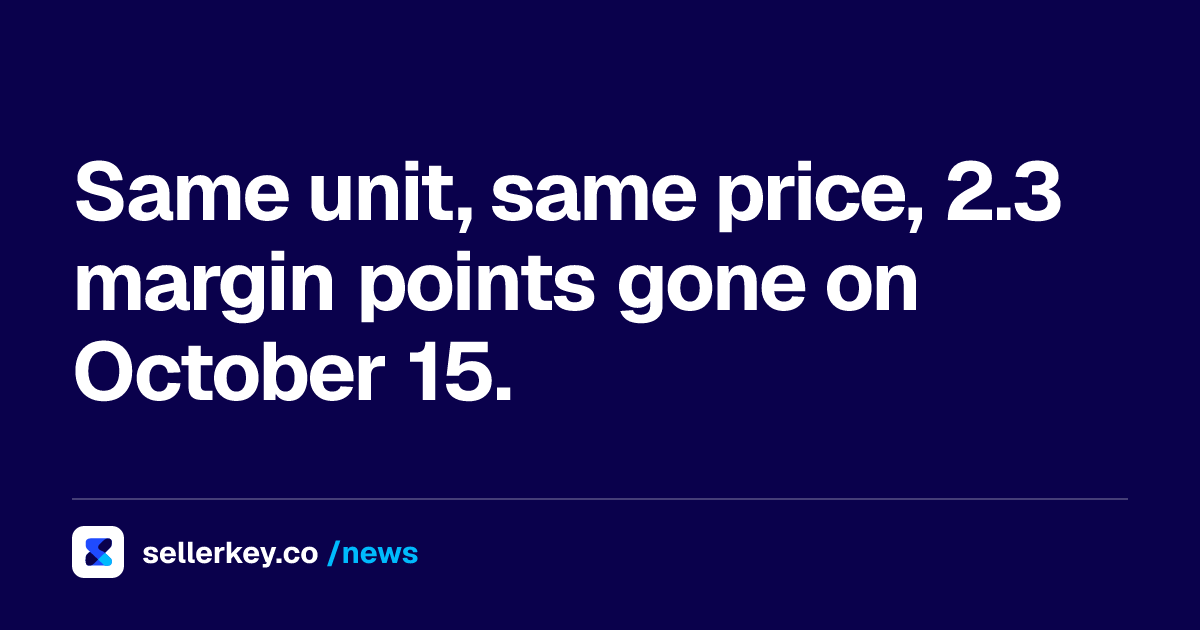
The same unit at the same price gives up $0.58 more, which is 2.3 points of margin. Nothing about the product changed. Only the date did.
Now add the one that compounds. If that unit is still sitting there at 271 days, the aged inventory surcharge adds 0.08 cubic feet at $5.45, so $0.44 per unit per month on top of storage. A unit you would not discount at $2 off is quietly costing you more than that to keep.
What to do with this
Price the calendar, not just the catalog. Three decisions come straight out of the numbers above:
- Anything you will not sell before October 1 is paying triple rent from that date. Removals ordered in October do not clear in October, so the decision window is September.
- Check your size tier before peak, not after the invoice. The tier sets the fulfillment fee, and the peak increase is applied on top of whatever tier you are in.
- Watch days of supply in both directions. Too much inventory triggers storage and the aged surcharge. Too little triggers the low-inventory-level fee.
If you are new to the model itself rather than the pricing, start with what Amazon FBA is and how it works and come back here for the numbers.
SellerKey does not change your prices, your listings or your shipments. It reads your fee and settlement data and shows each charge against the unit that carried it, which is the view the fee report does not give you.
“In 2026, FBA fees will increase by an average of $0.08 per unit sold, or less than 0.5% of an average item's selling price.”
Amazon Selling Partners
Sources
- Amazon Selling Partners: 2026 Amazon Referral & FBA Fee Updates sellingpartners.aboutamazon.com
- Amazon Seller Central: Referral fees sellercentral.amazon.com
- Amazon Seller Central: FBA fulfillment fee sellercentral.amazon.com
- Amazon Seller Central: Monthly inventory storage fees sellercentral.amazon.com
- Amazon Seller Central: Aged inventory surcharge sellercentral.amazon.com

Hey! I'm Amara
Press at SellerKey.co
☕ Espresso. Never a latte macchiato.
I cover Amazon fee and policy changes: what changed, when it applies and where Amazon published it.