Key takeaways
- Amazon's 2026 holiday peak fulfillment fees run from October 15, 2026 to January 14, 2027, with an average increase of $0.32 per unit.
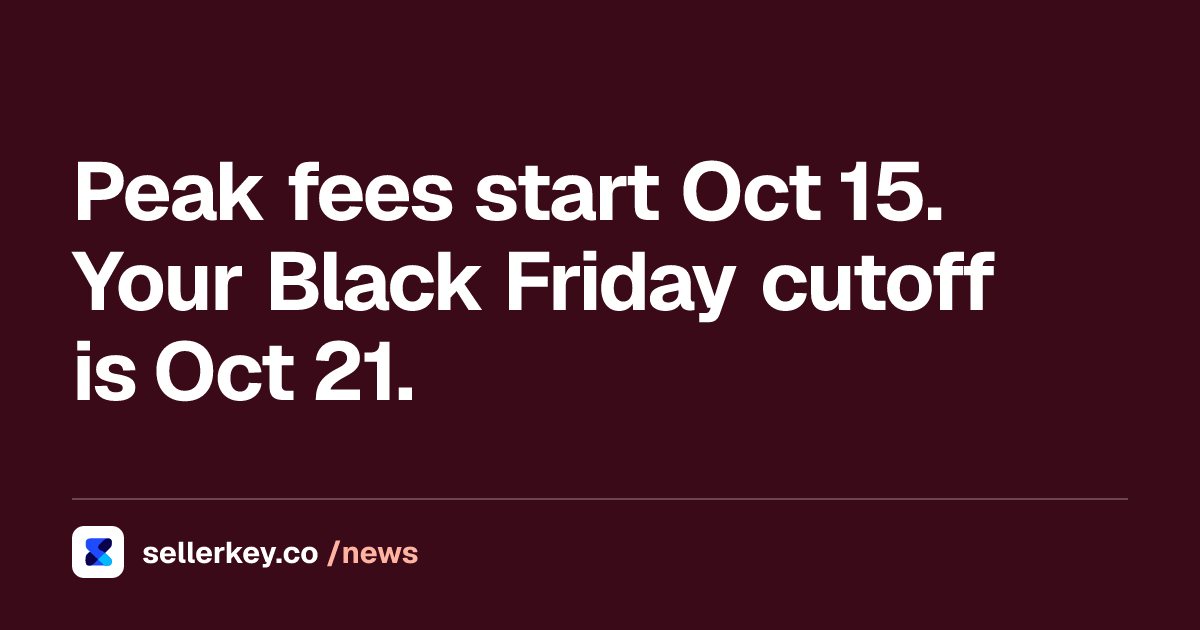
- The Black Friday inbound cutoff is October 21, six days after peak fees begin, meaning all Black Friday inventory ships at peak rates.
- A 3.5% fuel and logistics surcharge applies on top of the holiday peak fee, not the base fee, compounding the cost increase.
- Fulfillment fees depend on shipment date, not product SKU, making per-window pricing essential for accurate margin modeling.
- Sellers should split forecasts at October 15 and carry two price points per SKU to reflect off-peak and peak fulfillment costs.
Every seller who has run a fourth quarter on Amazon has had roughly the same January. You open the settlement report expecting the margin you modeled in August, and it is lower. Not on one product. Across the catalog.
Usually nobody made a mistake. What happened is that you priced a catalog when the thing that needed pricing was a calendar.
What Amazon published for 2026
Holiday peak fulfillment fees apply from October 15, 2026 to January 14, 2027. They cover FBA, Remote Fulfillment with FBA, Multi-Channel Fulfillment and Buy with Prime.
The increase over non-peak rates averages 0.32 USD per unit — the same per-unit step as last year. The 3.5% fuel and logistics surcharge applies on top of the holiday peak fee, not on top of the base fee.
The inbound receiving cutoffs are September 9, 2026 for Prime Big Deal Days (September 16 in the UK) and October 21, 2026 for Black Friday week (October 28 in the UK). Deal submission closes September 23 for Prime Big Deal Days and November 18 for Black Friday Week.
None of that is hidden. Amazon gave months of notice and held the rate steady, which is more warning than most cost inputs in this business give you.
The gap almost nobody models
Put two of those dates side by side.
- Peak fees begin: October 15
- Black Friday inbound cutoff: October 21
The deadline to have your Black Friday inventory received sits six days inside the window that costs more.
That is not a scheduling inconvenience you can optimize around. It is structural. There is no shipping plan in which your Black Friday units fulfill at off-peak rates, because the date by which they must arrive is already past the date the higher rate took effect. The entire Black Friday cohort ships at peak pricing, by construction.
And the surcharge compounds it. Because the 3.5% applies to the elevated fee, the effective increase is slightly more than the headline per-unit step. Modeling the surcharge against the base fee is a common and quiet error — it understates the number in exactly the direction that feels reassuring.

The principle underneath
Here is the part that will still be true when the 2027 rate card replaces this one:
A fulfillment fee is not a property of a product. It is a property of a shipment date.
Most pricing models get this wrong by design. They store one fee per SKU, computed once, and treat it as a fixed attribute — like weight or dimensions. But weight does not change on October 15. The fee does.
The moment a fee schedule has effective dates, unit economics stop being a per-product question and become a per-product-per-window question. A SKU that clears a healthy margin in September can be a break-even SKU in November without a single input changing except the calendar.
This generalizes well beyond peak fees. Storage rates step up in the fourth quarter. Aged inventory surcharges depend on how long a unit has been sitting. Referral and fulfillment rate changes land on announced dates. In every case the cost attaches to when, not to what.
What to actually do in September
Split the forecast at October 15. For each SKU, estimate what share of fourth-quarter volume ships before that date and what share ships after. That ratio, not the total, is what determines your blended fee.
Carry two numbers per SKU. The price that works at off-peak fulfillment cost, and the price that works at peak. If they are the same number, you have decided to absorb the difference — which is a legitimate choice, but it should be a choice.
Stress the light and fast movers. A flat per-unit increase is regressive against low-priced, high-velocity items. A 32-cent step is trivial against a 90 dollar product and material against an 11 dollar one. The SKUs that look safest in an averaged spreadsheet are usually the ones taking the most damage.
Apply the surcharge in the right order. Peak fee first, then 3.5% on that figure.
Check what the deal calendar does to the mix. Discounted units still carry full fulfillment cost. A promotion that works at September economics can invert at November economics, because the fee is flat while the revenue just came down.
Why this repeats every year
The fees are never the surprise. They are published, dated, and usually flat year over year. The surprise is always the calendar — the gap between the cost you modeled and the cost that applies on the day the unit actually moves.
Sellers who look at this in September are making a decision. They can change a price, change a pack configuration, change what they send, or accept the hit knowingly.
Sellers who look at it in January are reading a receipt.
The dates are on the table. Peak runs October 15 to January 14. Black Friday inventory is due October 21. The only open question is which of those two months you do the arithmetic in.
Sources
- Seller Central Forums - Holiday 2026: Same fees, same eligibility, earlier deadlines sellercentral.amazon.com
- Seller Central Forums - Peak season 2026: Inventory dates, peak fees, deal cutoffs and promotions sellercentral.amazon.com
- Seller Central - 2026 US FBA fulfillment fee changes sellercentral.amazon.com
- Ecommerce North America - Amazon announces 2026 holiday fulfillment fees and Q4 deadlines ecommercenorthamerica.org

Hey! We're the SellerKey Team
Data & product at SellerKey.co
📊 We build SellerKey.
The team behind SellerKey. We write about fees, margin, inventory and ads for Amazon sellers.