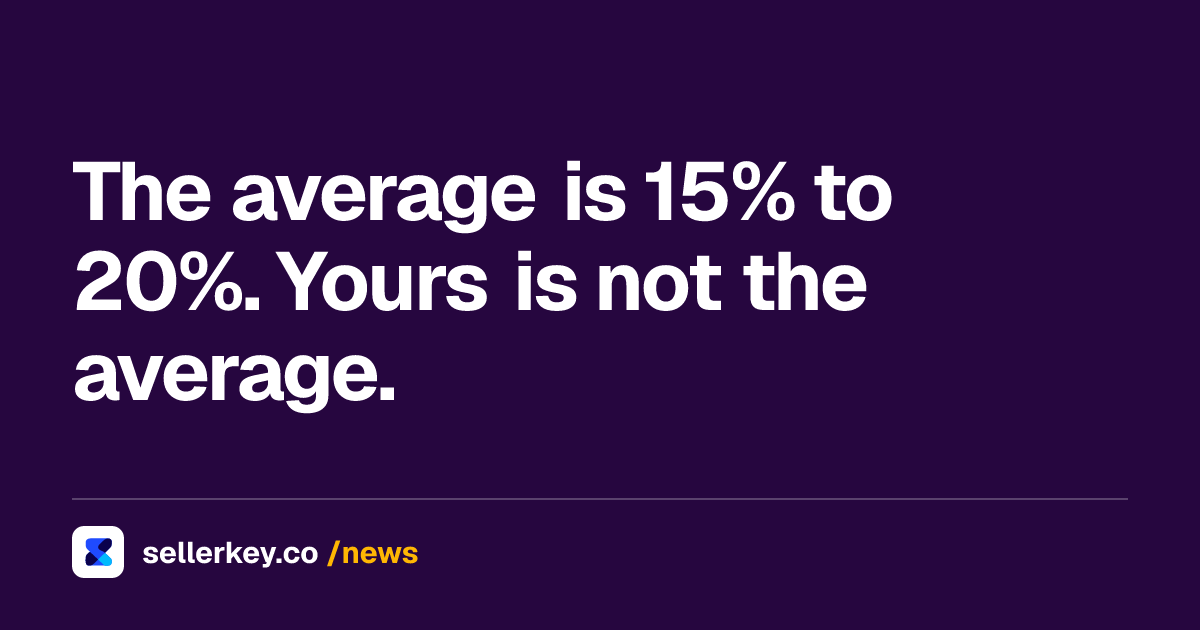
15% to 20%
net margin most FBA sellers report in seller surveys
+$0.08
average FBA fee increase per unit, effective January 15, 2026
+$0.32
average peak fee per unit, October 15 2026 to January 14 2027
Key takeaways
- Seller surveys put the average FBA net margin at 15% to 20%, with 57% of sellers above 10% and about 28% above 20%.
- FBA fees rose an average of $0.08 per unit on January 15, 2026, with no new fee types and at least 90 days of notice.
- Holiday peak fees run October 15, 2026 to January 14, 2027 and average $0.32 more per unit than non-peak.
- Standard-size non-peak storage has been $0.78 per cubic foot from January to September since April 1, 2024.
- Compute margin per SKU and twice, at peak and non-peak rates. A blended average hides the SKUs selling below cost.
Ask what the average Amazon FBA profit margin is and you get a band: roughly 15% to 20% net, with seller surveys reporting that 57% of sellers hold margins above 10% and about 28% clear 20%. Those figures come from seller surveys rather than from Amazon, so treat them as a sanity check, not as a target.
The useful number is not the average. It is yours, and it is built from a fee stack you can read line by line.
What the average Amazon FBA profit margin actually measures
Net margin here means profit after everything: cost of goods, Amazon's fees, storage, advertising and returns. Surveys that report 15% to 20% are mixing business models that cannot share a number. Private label sellers who own the listing and the pricing are reported in the 25% to 30% range; wholesale and arbitrage sellers, competing on price for a shared Featured Offer, land nearer 10% to 20%.
So two sellers with identical revenue and identical margins can be running completely different businesses. The band tells you whether you are roughly sane. It cannot tell you where your money goes.
The fee stack, with the date each rate starts
These are the lines that stand between your selling price and your margin.
Referral fee. A percentage of the total sales price, varying by category, with a minimum of $0.30 in the US. Several categories carry reduced rates at low price points: Beauty, Health and Personal Care and Baby charge 8% at or below $10, Grocery 8% at or below $15, and Apparel drops from 17% to 5% below $15 and to 10% between $15 and $20.
FBA fulfillment fee. Per unit, set by size tier and weight. For 2026, Amazon raised FBA fees by an average of $0.08 per unit, effective January 15, 2026, with no new fee types introduced. The average hides the spread: small standard-size units priced above $50 rose by about $0.51 per unit and large standard-size by about $0.31. Amazon also commits to at least 90 days of notice before a fee increase takes effect.
Peak fulfillment fee. From October 15, 2026 to January 14, 2027, holiday peak fulfillment fees apply to FBA, Remote Fulfillment with FBA, Multi-Channel Fulfillment and Buy with Prime, averaging $0.32 more per unit than non-peak. Same per unit increase as the previous year. Our breakdown of the 2026 peak fulfillment fees has the detail.
Monthly inventory storage. Charged per cubic foot on a snapshot of your stored volume. For standard-size inventory the non-peak rate has been $0.78 per cubic foot from January through September since April 1, 2024, down from an average of $0.87. The October to December rate is materially higher, which is why Q4 storage deserves its own calculation.
Everything else. Aged inventory surcharges, the low-inventory-level fee, inbound placement, returns processing, removals and disposals. Each is small and none is optional once triggered. The full map of FBA fees with their effective dates covers them individually, and the low-inventory-level fee has its own 28 day threshold.
A worked example, end to end
A large standard-size unit, 14 ounces, sold in a 15% referral category at $29.99, with goods landed at $7.00 and advertising running at 9% of revenue.
| Line | Amount |
|---|---|
| Selling price | $29.99 |
| Referral fee at 15% | -$4.50 |
| FBA fulfillment fee | -$3.28 |
| Cost of goods landed | -$7.00 |
| Advertising at 9% of revenue | -$2.70 |
| Monthly storage, 0.12 cubic feet at $0.78 | -$0.09 |
| Returns and reimbursement leakage at 2% | -$0.60 |
| Net profit per unit | $11.82 |
That is a net margin of 39.4% before overhead, which sounds excellent and is not the number to report. Add the October 15 peak fee of roughly $0.32 per unit, move storage to the Q4 rate, and let advertising drift to 14% in a competitive December, and the same unit nets about $9.60, or 32%. Nothing changed about the product. The calendar changed.
Check the fulfillment fee figure above against your own rate card before you plan around it: per tier amounts move, and the tier Amazon assigns after remeasurement is the one that bills.
What to do with the number
Compute margin per SKU, never as a blended average across the catalogue. A blended 20% usually hides a third of the catalogue selling below cost and a third carrying everything.
Then run it twice, once at non-peak rates and once at peak. A SKU that nets 8% in September does not survive October 15. That is a decision you make in September, with a removal order or a price change, not one you discover on the January statement.
Keep the fee lines separate from cost of goods in whatever you use to track this. The referral fee is a function of price, the fulfillment fee of dimensions, storage of time, and advertising of competition. They respond to completely different decisions, and averaging them into a single "Amazon takes 30%" figure removes the only information you could have acted on.
“You have at least 90 days before any fee increases take effect.”
Amazon Selling Partners
Sources
- Amazon Selling Partners: actualización de comisiones y tarifas de FBA en EE. UU. para 2026 sellingpartners.aboutamazon.com
- Amazon Seller Central: referencia de tarifas de almacenamiento de FBA sellercentral.amazon.com
- Amazon Seller Central: referencia de ayuda sobre tarifas sellercentral.amazon.com
- Benchmarks de margen de FBA que recogen la encuesta State of the Amazon Seller sellerforge.ai

Hey! I'm Amara
Press at SellerKey.co
☕ Espresso. Never a latte macchiato.
I cover Amazon fee and policy changes: what changed, when it applies and where Amazon published it.