$0.78
per cubic foot a month, standard size, January to September, since April 1, 2024
$5.45
aged inventory surcharge per cubic foot from day 271, since January 16, 2026
3.6x
jump in the surcharge between day 270 and day 271
Key takeaways
- The standard-size monthly storage fee is $0.78 per cubic foot from January through September, in force since April 1, 2024.
- It is billed on daily average volume in cubic feet, not on units, so a light product in a big box pays like a heavy one.
- Since January 16, 2026 the aged inventory surcharge runs from $0.50 per cubic foot at 181 days to $7.90 beyond 456 days.
- Between day 270 and day 271 the surcharge jumps from $1.50 to $5.45 per cubic foot, about 3.6 times more.
- Surcharges are assessed on the 15th, so a removal order has to be in by 11:59 PM PT on the 14th to spare those units.
Amazon FBA storage fees are two charges, not one, and they are billed on space, not on units. Amazon rents you shelf space by the cubic foot and bills it monthly, then adds surcharges when inventory sits too long or takes up more room than your sales justify.
How the monthly inventory storage fee is calculated
Amazon staff describe the structure in the Seller Central forums: the fee is calculated on your daily average volume in cubic feet, and it has two components. A base monthly storage fee, set by product size and time of year, plus a storage utilization surcharge that only applies to some sellers.
Two consequences people miss. First, it is daily average volume, so units that arrive on the 28th barely cost anything that month. Second, it is volume, so a light product in a big box pays like a heavy one.
The rate per cubic foot, and the date it has applied since
For standard-size products, the non peak monthly rate is $0.78 per cubic foot, covering January through September. That number is not an estimate: Amazon cut it from $0.87 to $0.78, an average reduction of $0.09, effective April 1, 2024, and said in the same notice that non-standard-size rates would remain unchanged.
From October through December the standard-size rate goes up, and oversize is higher all year with its own peak increase. Amazon publishes the current peak figure on the monthly storage fees page inside Seller Central, and that is the rate that decides your December invoice, so read it there before you plan Q4. Our breakdown of what FBA storage costs in October walks through the Q4 jump itself.
For 2026, Amazon said there would be no new FBA fee types and that fulfillment fees would rise about $0.08 per unit sold on average, effective January 15, 2026.
The storage utilization surcharge
This is the one that catches growing accounts. It applies when your average daily inventory is large relative to your recent average daily shipped volume over 13 weeks, and Amazon says plainly that it is designed to discourage excess inventory storage. It varies by product size and by your utilization ratio.
In other words: the same pallet costs one seller nothing extra and costs another seller a surcharge, because the difference is how fast it sells. If your restock planning pushes you toward overstock, Amazon's restock limits are the other half of the same picture.
The aged inventory surcharge, tier by tier
This is where storage stops being a rounding error. Starting January 16, 2026, Amazon charges aged inventory surcharges by how long a unit has been in storage:
| Days in storage | Surcharge per cubic foot |
|---|---|
| 181 to 210 | $0.50 |
| 211 to 240 | $1.00 |
| 241 to 270 | $1.50 |
| 271 to 300 | $5.45 |
| 301 to 330 | $5.70 |
| 331 to 365 | $5.90 |
| 366 to 455 | $6.90, or $0.30 per unit, whichever is greater |
| 456 and over | $7.90, or $0.35 per unit, whichever is greater |
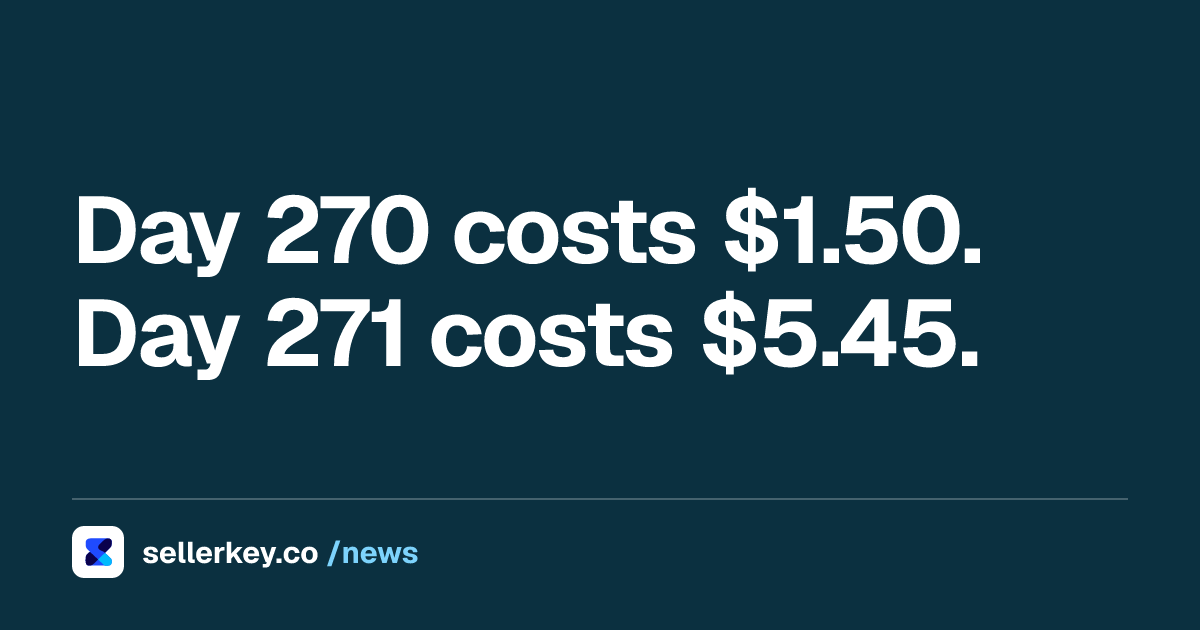
Look at the step between day 270 and day 271. The surcharge goes from $1.50 to $5.45 per cubic foot, about 3.6 times more, in one day. Clothing, shoes, bags, jewelry and watches are excluded.
The calendar matters as much as the table. Amazon assesses these surcharges monthly on the 15th and charges them between the 18th and the 22nd, on top of the regular monthly storage fee. Removal or disposal orders have to be submitted by 11:59 PM PT on the 14th of the month to keep those units out of that month's assessment. Fulfillable inventory stored more than 365 days can also be set to be removed automatically.
One caveat from the same thread, worth knowing before you build a process on it: a seller points out that the inventory filters in Seller Central do not offer a 271 to 300 day range, which makes the most expensive step the hardest one to filter for. Amazon did not answer that in the thread.
A full example, end to end
Take 500 units of a standard-size product at 0.4 cubic feet each, so 200 cubic feet of space.
- In March, at $0.78 per cubic foot: 200 x $0.78 = $156 for the month.
- Say 300 of those units still have not sold and cross day 271 before the assessment on the 15th. Those 300 units are 120 cubic feet, at $5.45: 120 x $5.45 = $654 in surcharge.
- Total that month: $810, against $156 the month before. Nothing changed except the calendar.
That is the whole argument for ordering the removal on the 13th rather than the 16th. The decision is worth $654 and takes two minutes.
What to do with this
Three numbers decide your storage bill: cubic feet, days in storage, and how fast you ship. Pull the days in storage figure from your inventory age report every month before the 14th, and treat the 181, 271 and 366 day marks as deadlines rather than statistics. When a unit is going to cross one of them, the removal order is almost always cheaper than the surcharge, and the comparison is the same arithmetic as in how to calculate Amazon FBA profit.
Units that cannot be sold at all are a different problem with its own clock, and we cover it in why FBA inventory goes stranded.
“Designed to discourage excess inventory storage.”
Amazon Seller Central
Sources
- Amazon Selling Partners: Update to US referral and Fulfillment by Amazon fees (almacenamiento estandar a 0,78 $, 1 de abril de 2024) sellingpartners.aboutamazon.com
- Amazon Seller Central: AVOID Costly Fees, Aging Inventory Action Plan (Angie_Amazon, tabla del recargo desde el 16 de enero de 2026) sellercentral.amazon.com
- Amazon Seller Central: How to calculate Monthly inventory storage fees (Cooper_Amazon, los dos componentes) sellercentral-europe.amazon.com
- Amazon Seller Central: Get Control of Your Amazon Storage Fees (NR_Amazon, recargo por utilizacion y 13 semanas) sellercentral.amazon.com
- Amazon Selling Partners: 2026 Amazon Referral y FBA Fee Updates (15 de enero de 2026, sin tipos nuevos) sellingpartners.aboutamazon.com

Hey! We're the SellerKey Team
Data & product at SellerKey.co
📊 We build SellerKey.
The team behind SellerKey. We write about fees, margin, inventory and ads for Amazon sellers.