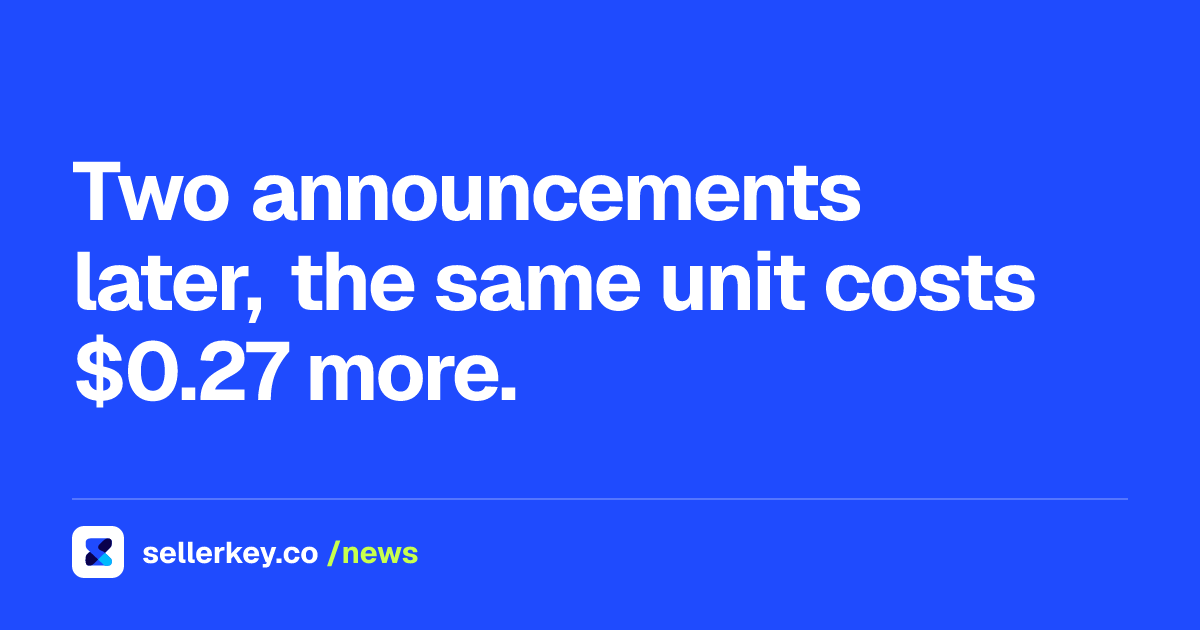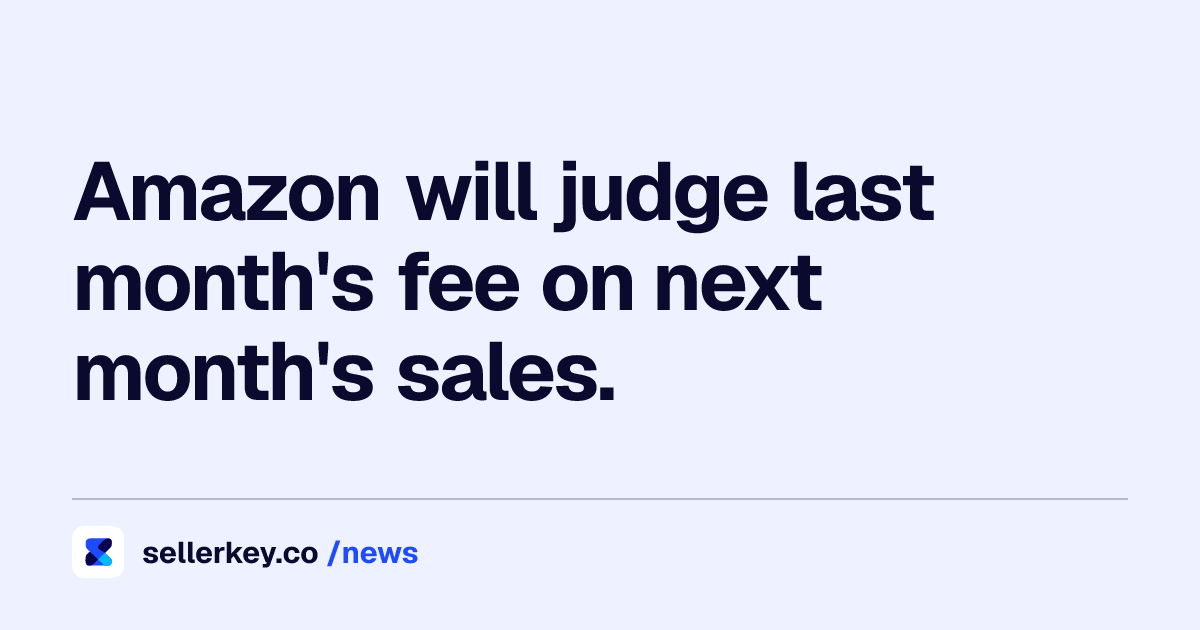
28 days
of supply: the trigger below which the fee applies, from February 1, 2027
4 weeks
of shipments after the assessment date now counted as evidence
$0.19
average FBA fulfillment fee increase per unit, from January 15, 2027
Key takeaways
- From February 1, 2027 the low-inventory-level fee applies only when inventory falls below 28 days of supply.
- Supply is measured on actual shipments in the four weeks before and the four weeks after the assessment date.
- Today the fee is assessed using trailing 30- and 90-day sales, so the test only looks backwards.
- A restock that checks in just after the assessment date lands inside the forward window Amazon reads.
- On the same date the storage utilization surcharge is eliminated and aged inventory folds into monthly storage.
Before you start
- A Professional selling account with FBA inventory in the US store.
- Your FBA inventory and restock data in Seller Central, with days of supply per SKU.
- Your expected inbound check-in dates for the next two months.
Step by step
- List the SKUs whose days of supply sit near 28Sort your FBA inventory and restock data by days of supply. You only need the SKUs hovering around the 28 day line: comfortably stocked SKUs and already stranded ones are not touched by the trigger change.
- Write each SKU's next inbound check-in date beside itThe fee is decided around an assessment date, and from February 1, 2027 the four weeks after that date count as evidence. A replenishment expected to check in just after it lands inside the window Amazon reads.
- Split the list into thin on purpose and thin by accidentMark the SKUs you are deliberately running down at the end of a season, and the ones that are low because a reorder slipped. The fee does not read your intent, but the forward window shows whether demand continued, and your reorder rules should treat the two differently.
- Reprice the decision to hold more coverOn February 1, 2027 the storage utilization surcharge is eliminated and the aged inventory surcharge is folded into monthly storage as a single age based rate. Carrying extra cover to stay above 28 days costs less to model after that date than before it.
- Reconcile the fee lines after the first assessmentOnce the change is live, match the low-inventory-level fee lines in your reports against the SKUs you flagged, and note which ones the forward window cleared and which it confirmed.
The Amazon 28 days of supply rule is how the low-inventory-level fee will decide you owe it. Today, Amazon says, "the fee is assessed using trailing 30- and 90-day sales." From February 1, 2027, in Amazon's words, "the fee will apply only when your inventory falls below 28 days of supply," and that supply is measured "based on actual shipments in both the four weeks before and after the assessment date."
Read the second half of that sentence again. Amazon is going to look at four weeks of shipments that have not happened yet when it decides whether a fee from last month sticks.
What the new low inventory level fee trigger actually measures
The current test looks backwards only. You sold at a certain rate over the last 30 and 90 days, your days of cover fell under the threshold, the fee applied.
The 2027 update adds a forward window. Amazon says that "by also evaluating sales in the four weeks after the inventory assessment," the change "confirms whether low inventory reflects ongoing demand." So the assessment date sits in the middle of an eight week window: four weeks of shipments before it, four weeks after it.
That is a better test. A SKU that ran thin because demand genuinely stayed high is a different situation from a SKU that ran thin because it stopped selling, and the old backward-only test could not tell them apart.
The three cases this changes
The seasonal tail. A SKU sells hard for six weeks, you let the stock run down on purpose, and sales fall off a cliff right after. Under the backward test, the low cover during the tail looks like a fee. Under the new test, the four weeks after the assessment date show the demand gone, which is the evidence that the low stock was not a missed opportunity.
The genuine stockout. Demand holds through the forward window and you were under 28 days of cover. The fee applies, and now it applies on stronger evidence. There is nothing to appeal here: the fix is inbound timing, not paperwork.
The late restock. This is the one worth planning. If your replenishment lands just after the assessment date, those units arrive inside the forward window. They do not retroactively raise your days of cover on the assessment date, but the shipments they generate are exactly what the forward window is reading.
Where this trips people up
The first mistake is reading 28 days as a target. It is a threshold, and clearing it on the assessment date is not the same as having enough stock, because the forward window still reads what actually shipped in the four weeks after.
The second is planning replenishment against the calendar month instead of the assessment date. A shipment that checks in a week late used to cost you cover on a single date. Now that same late shipment also lands inside the window Amazon reads afterwards.
The third is carrying over a rule you wrote under the old surcharges. Holding extra cover was priced differently when the storage utilization surcharge still existed, and from February 1, 2027 it does not.
How to confirm it worked
After the first assessment under the new rule, reconcile the low-inventory-level fee lines in your reports against the SKUs you flagged. A fee on a SKU whose demand genuinely stopped is the case the forward window is supposed to catch, and it is the one worth reading closely. A SKU you expected to be charged and was not tells you the forward window saw the demand continue.
What has not changed
The fee itself is not being abolished, and the 28 day figure is a trigger, not a target. The 2026 fee update set the FBA baseline this sits on: fees rose $0.08 per unit sold on average from January 15, 2026, with no new FBA fee types that year. For 2027, FBA fulfillment fees rise by $0.19 per unit sold on average, with most changes effective January 15, 2027, and Amazon published that update on November 5, 2026, more than two months ahead. The Seller Central announcement thread for the 2026 round is where sellers worked through what the averages meant per size tier, and the 2027 round will go the same way.
For how the fee works today, see the Amazon low inventory level fee and why am I being charged a low inventory level fee. For the rest of the 2027 changes, see Amazon FBA fee changes 2027.
“the fee will apply only when your inventory falls below 28 days of supply”
Amazon Selling Partners
Sources
- Amazon Selling Partners: Update to US Referral and Fulfillment by Amazon fees for 2027 (05-11-2026) sellingpartners.aboutamazon.com
- Amazon Selling Partners: 2026 Amazon Referral and FBA Fee Updates (15-10-2025) sellingpartners.aboutamazon.com
- Seller Central (foro): 2026 Updates to US Referral and Fulfillment by Amazon Fees sellercentral.amazon.com

Hey! We're the SellerKey Team
Data & product at SellerKey.co
📊 We build SellerKey.
The team behind SellerKey. We write about fees, margin, inventory and ads for Amazon sellers.