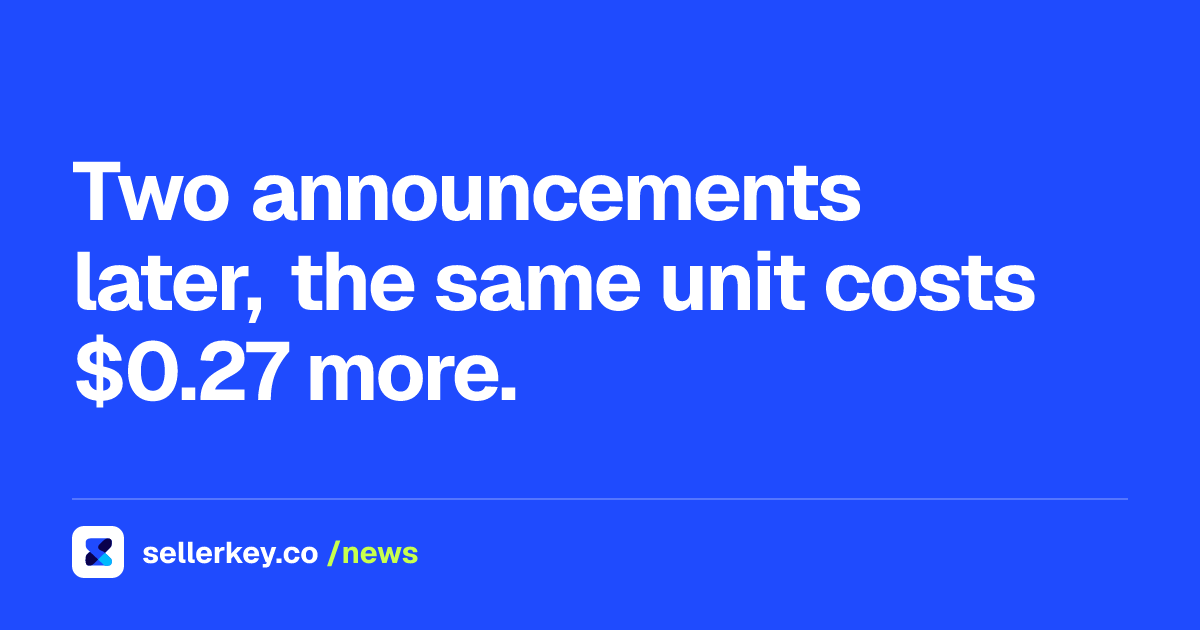
+$0.27
per unit from the 2026 and 2027 FBA fulfillment fee increases combined
3.5%
fuel and logistics surcharge on FBA fulfillment fees since April 17, 2026
28 days
of supply: the low inventory level fee threshold from February 1, 2027
Key takeaways
- FBA fulfillment fees rose about $0.08 per unit on January 15, 2026 and rise about $0.19 more on January 15, 2027.
- A 3.5% fuel and logistics surcharge has applied to FBA fulfillment fees since April 17, 2026, about $0.17 per unit for US FBA.
- A Professional selling account is $39.99 per month before any selling fee.
- On February 1, 2027 the storage utilization surcharge disappears and the low inventory level fee applies only below 28 days of supply.
- At 1,000 units a month the two increases plus the surcharge are about $480 a month of cost that did not exist in 2025.
Is Amazon FBA still worth it? It is, for units with enough margin to absorb two fee increases and one surcharge, and it is not for the rest. The answer is arithmetic, not opinion: the fee side is the same for every seller in the US store, and the only variable is your contribution margin per unit.
Before a single unit sells, a Professional selling account costs $39.99 per month plus selling fees. That part has not moved. What moved is the per unit side, twice in two years.
What Amazon FBA charges per unit
Four charges stack on the same unit:
- The referral fee, taken as a percentage of the total sales price. A seller quoting Amazon's fee explanation for Office Products in the US store puts it at 15% of the total sales price with a minimum of $0.30 per item. Amazon's full fee schedule sits behind a Seller Central login, so treat the category table as something to confirm in your own account.
- The FBA fulfillment fee, set by size tier and item price.
- Monthly inventory storage, set by size and time of year.
- The fuel and logistics related surcharge, a percentage of the fulfillment fee.
Our breakdown of how Amazon FBA fees are built, fee by fee covers each line. This article is about what the stack now adds up to.
The two increases that changed the answer
Amazon raised FBA fulfillment fees by about $0.08 per unit sold on average, effective January 15, 2026, which it described as less than 0.5% of an average item's selling price, with no new FBA fee types that year.
Then, on November 5, 2026, Amazon announced that fulfillment fees rise by about $0.19 per unit sold on average, effective January 15, 2027, roughly 0.8% of the average item's selling price, with some fees going down.
Between those two announcements came the surcharge. Starting April 17, 2026, a 3.5% fuel and logistics related surcharge applies to FBA fulfillment fees in the US and Canada, which Amazon estimated at about $0.17 per unit for US FBA. It is calculated on your fulfillment fees, not on the sale price of your items. The 2027 announcement confirms the surcharge is unchanged.
Add the two base increases and the same unit costs $0.27 more to fulfill in 2027 than it did before January 15, 2026. The surcharge sits on top of that.
What gets cheaper on February 1, 2027
Three changes land that day, and two of them are in your favor:
- The storage utilization surcharge is eliminated.
- The aged inventory surcharge disappears as a separate charge and is folded into monthly storage as a single age based rate. Inventory that turns in under six months sees flat or lower fees; aged inventory sees higher fees.
- The low inventory level fee applies only when inventory falls below 28 days of supply, measured against actual shipments in the four weeks before and after the assessment date instead of trailing 30 and 90 day sales.
So the fee drift is not one directional. If your stock turns fast, February 2027 gives some of the increase back. If it sits, you pay more than you do today. Our piece on what the 2027 FBA fee changes cover, date by date has the full calendar.
A worked example at 1,000 units a month
Only verified numbers here:
- Professional plan: $39.99 a month, which is $0.04 per unit at this volume.
- Base fee drift: $0.08 (2026) plus $0.19 (2027) is $0.27 per unit, or $270 a month and $3,240 a year.
- Surcharge: about $0.17 per unit on average for US FBA, or $170 a month.
That is roughly $480 a month of cost that did not exist in 2025 at the same volume, before any referral fee, storage or returns.
Now the part that decides it. If your contribution margin is $4.00 per unit, the $0.44 of new per unit cost is 11% of that margin: FBA still works, and you have room. If your margin is $1.00 per unit, the same $0.44 is 44% of it, and FBA is no longer the right fulfillment choice for that SKU at that price. Nothing about the catalog changed. The threshold did.
So is Amazon FBA still worth it
Worth it, per SKU, if the unit clears three tests:
- Contribution margin per unit above roughly $2.50 after the referral fee, the fulfillment fee and the surcharge, so a $0.27 drift is noise rather than the difference.
- Stock that turns in under six months, which is what the February 1, 2027 storage rate rewards.
- Enough weeks of cover to stay above 28 days of supply without overshooting into aged inventory.
A SKU that fails all three does not fail because FBA stopped working. It fails because its margin was always thin enough that two average increases decided it. Our numbers on the average FBA profit margin and where it goes show how little room the median seller has.
What to check in your own account this week
Amazon updates the Revenue Calculator and the Fee and Economics Preview report with each year's rates, and those are the only two places where your exact fulfillment fee per size tier appears. Pull both, sort your SKUs by contribution margin per unit, and look at the bottom of that list: those are the units that the 2027 rates decide for you. If FBA is new to you, start with what Amazon FBA is and how it works before running the numbers.
Sources
- Amazon Selling Partners: update to US referral and FBA fees for 2026 sellingpartners.aboutamazon.com
- Amazon Selling Partners: update to US referral and FBA fees for 2027 sellingpartners.aboutamazon.com
- Amazon Seller Central: Professional selling account, 39,99 $ al mes sellercentral.amazon.com
- Amazon Seller Forums: fuel and logistics related surcharge (FBA, MCF, BWP en US y CA) sellercentral.amazon.com
- Amazon Seller Forums: comision por referencia de Office Products, 15 % con minimo de 0,30 $ sellercentral.amazon.com

Hey! I'm Amara
Press at SellerKey.co
☕ Espresso. Never a latte macchiato.
I cover Amazon fee and policy changes: what changed, when it applies and where Amazon published it.