3 / 180 days
eligible listing-level decisions you can send to Seller Challenge
48 hours
turnaround reviewers aim for on a challenge
250
Account Health Rating needed for 6 months to qualify for Assurance
Key takeaways
- Seller Challenge allows reviews of eligible listing-level policy decisions three times every 180 days.
- Reviewers aim to decide within 48 hours, and a failed challenge is restored after six months.
- It only works for sellers enrolled in Account Health Assurance, confirmed by the banner in the Account Health dashboard.
- Account Health Assurance needs an AHR of 250 or higher for at least 6 months, with no more than 10 days below it.
- Enrolled sellers must reply within 72 hours when Amazon reaches out, and serious violations can still bring immediate action.
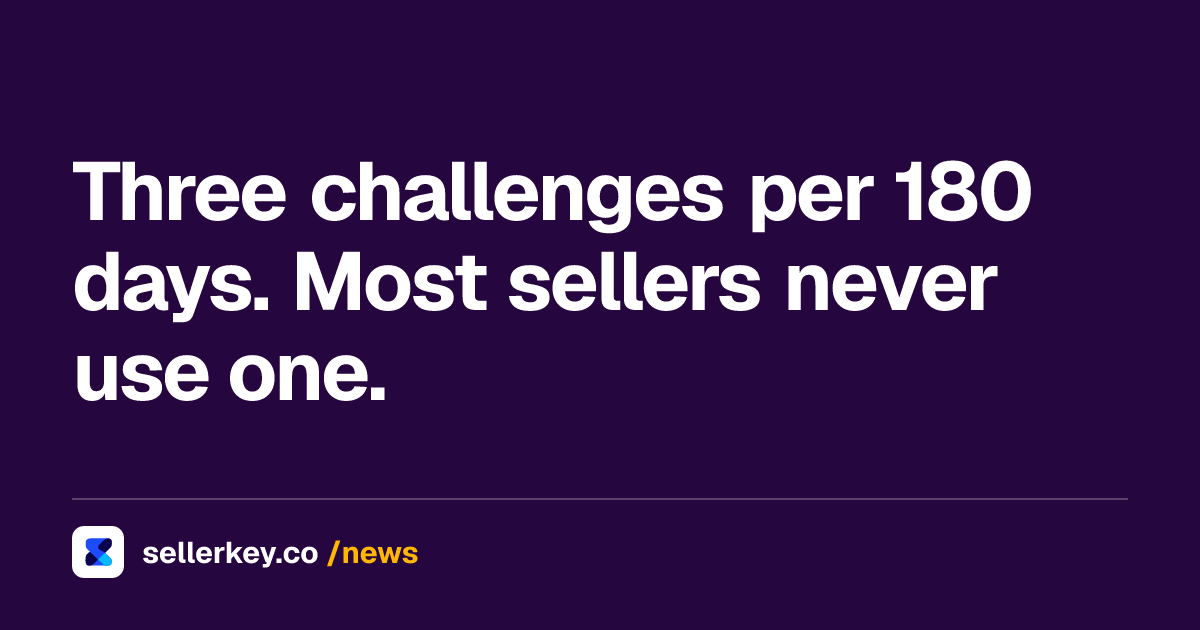
Amazon Seller Challenge is a second look. It lets a seller request more detailed information about enforcements on the account after the standard appeal options have been used, and it is capped: Amazon's announcement that Seller Challenge launched for Account Health Assurance says you can request reviews of eligible listing-level policy decisions "three times every 180 days", and that reviewers "aim to provide decisions within 48 hours".
Three is the whole budget. That is the part worth internalising before the next suppression lands.
Who actually has it
Seller Challenge is not open to every account. It rides on Account Health Assurance, and that program has its own gate. Amazon's Account Health Assurance post lists the criteria: a professional selling account, an Account Health Rating of 250 or higher held "for at least 6 months (with no more than 10 days below this threshold)", and a valid emergency contact number on file. Qualifying sellers are automatically enrolled at no added cost.
There is a duty attached. When Amazon reaches out about an issue, you have to reply within 72 hours. And Amazon says serious violations, fraud among them, may still bring immediate action including deactivation.
Do the arithmetic on that eligibility window and it gets uncomfortable. Six months is about 183 days, so 10 days below 250 is roughly 5.5% of the window. One bad fortnight, one unanswered compliance request that drags, and the program you were counting on in November is not there in December. The Account Health Rating is the gate, not the consequence.
To check whether you are in, Amazon says to review the banner in the top right corner of the Account Health dashboard. Do that before you need it, not after.
The budget, spent properly
Three eligible listing-level decisions every 180 days works out to roughly one every 60 days. A failed challenge is restored after six months, so a loss is not permanent, but it is not free either: it is two months of your allowance gone.
Say two ASINs get suppressed in the same week in January. One is a seasonal unit you were going to let die anyway. The other is 40% of your revenue. Challenge both and you have one left until July, and July is when Q3 compliance sweeps tend to find things. Challenge the second only, and you keep two in reserve through the first half of the year.
That is the decision this feature actually asks of you, and it is not a compliance decision. It is a triage decision, and it needs a list of which listings carry the revenue before the suppression email arrives, not after.

Where it sits in the sequence
Seller Challenge is not the first move. It is for after the standard appeal: Amazon frames it as requesting more detailed information about enforcements once those options have been used. If you have not filed the normal appeal, you do not have a challenge to make yet. Our walkthrough of appealing an Amazon seller account suspension covers that earlier step.
It is also listing-level. Amazon says eligible listing-level policy decisions, and the announcement does not publish the list of what is ineligible. Treat anything account-level as outside this door until Amazon says otherwise.
This fits a pattern Amazon has been building all year: consequences aimed at the offer rather than the whole account. That is the same logic behind Amazon OTDR listing deactivation. At Accelerate 2026 Amazon went further, describing a Listing Protection program under which a flagged listing stays live while the seller resolves the issue, reaching all US Account Health Assurance sellers by year-end and worldwide in 2027. The executive quote is hedged: "In most cases, your listing stays active until we issue a decision."
What to be sceptical about
Enrolment is not a guarantee, and sellers say so. In the forum thread What good is Account Health Assurance if Amazon deactivates your account with no prior warning? an enrolled seller reports being deactivated without outreach over suspected fraud. That is one account and not data, but it lines up with Amazon's own carve-out for serious violations, so plan around it rather than against it.
The useful reading is narrow and practical. Account Health Assurance plus Seller Challenge gives you a limited right to a faster, more detailed second look on listing decisions, with a 48 hour target and three uses a half year. It does not give you immunity.
What to do with this before you need it
Confirm the banner, keep the emergency contact current, and know which 10 or 20 ASINs you would actually spend a challenge on. The 48 hour turnaround only helps if the decision about whether to use one takes minutes rather than days, and that depends entirely on whether you already know what each listing is worth.
“Sellers can request reviews of eligible listing-level policy decisions three times every 180 days.”
Amazon Seller Central
Sources
- Amazon Seller Central: Seller Challenge launches for Account Health Assurance sellercentral.amazon.com
- Amazon Seller Central: Protect your account from deactivation with Account Health Assurance sellercentral.amazon.com
- Amazon Selling Partners: Accelerate 2026 recap (Listing Protection) sellingpartners.aboutamazon.com
- Amazon Seller Forums: What good is Account Health Assurance if Amazon deactivates your account with no prior warning? sellercentral.amazon.com

Hey! We're the SellerKey Team
Data & product at SellerKey.co
📊 We build SellerKey.
The team behind SellerKey. We write about fees, margin, inventory and ads for Amazon sellers.