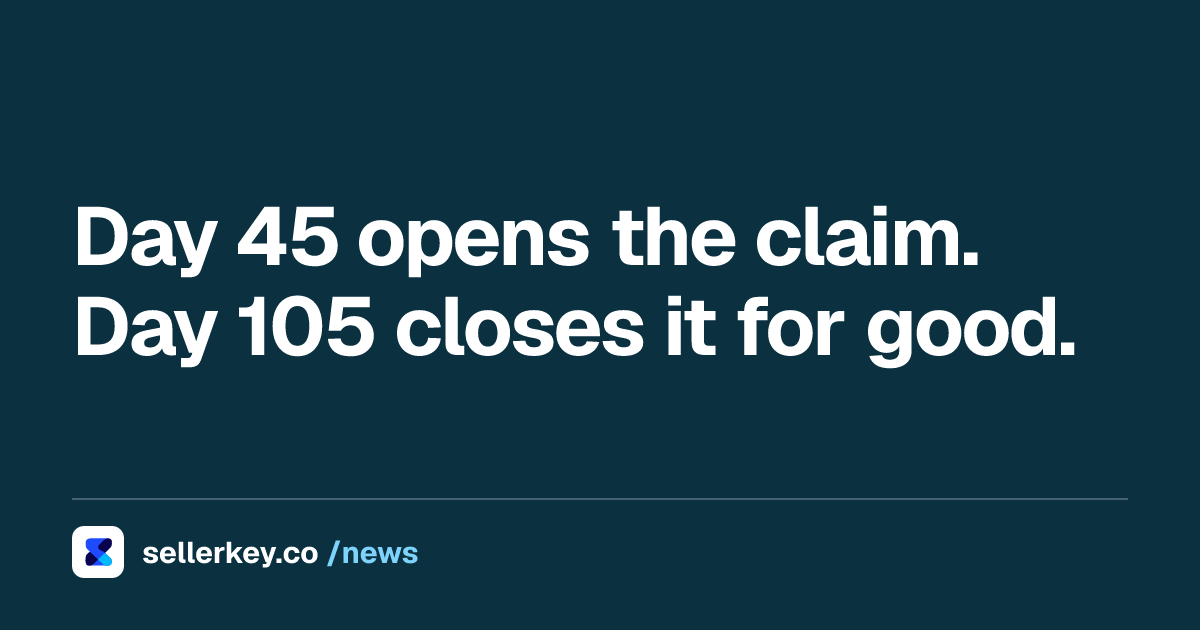
45 days
before this, a claim for an unreceived customer return is not eligible
105 days
after this, the window from the refund date is closed for good
Sale price
the basis for a loss after a customer order, minus applicable fees
Key takeaways
- A customer return that was refunded and never received back is covered by the FBA inventory reimbursement policy.
- Since September 5, 2024 the claim opens no sooner than 45 calendar days from the refund date and closes at 105.
- A loss after a customer order is reimbursed at the sales price on the original order minus applicable fees.
- A credit landing near your manufacturing cost on a refunded return was valued under the pre order rule.
- Nothing emails you on day 45 or day 105: the Reimbursements report is the only place the credit appears.
Before you start
- A professional seller account with access to the Reimbursements report in Seller Central, under Reports and then Payments
- The order id and the exact date Amazon refunded the customer
- The sale price on that original order and the fees charged on it
Step by step
- Write down the date Amazon refunded the customerBoth deadlines count from that single date, not from the return request and not from the day you noticed the unit was missing. Every step below is measured against it.
- Check the Reimbursements report before you file anythingAmazon credits part of these on its own. Look for a line tied to the order id. If a credit is already there, the job is to check the amount, not to open a claim.
- Wait until day 45, and do not file earlierThe window opens no sooner than 45 calendar days from the refund date. A case opened before that comes back rejected for the date, which sellers routinely read as a rejection of the claim itself.
- File between day 45 and day 105 with the order id and the refund dateThe window closes at 105 calendar days from the refund date and nothing reopens it. State plainly that the customer was refunded and the unit was never received back into sellable inventory.
- Ask for the post order valuation in the case itselfWrite that the loss happened after a customer order, so the reimbursement is the sales price on the original order minus applicable fees, not the product manufacturing cost. Attach the order detail that shows the sale price.
- If it was a non returnable item, raise it as lost inventory insteadSellers report that returnless refunds get denied as customer return claims. The same loss opened as a lost inventory case is a different queue with a different window, so do not keep re-filing the rejected one.
- Match the credit to the order and only then close itThe case is resolved when the Reimbursements report shows a line for that order id with an amount built from the sale price minus the fees on it. Anything near your sourcing cost is the wrong rule applied.
Amazon refunded the customer but I never got the item back, and the refund has already left your account. The unit is gone, the money is gone, and nothing in Seller Central tells you that a clock started. Two clocks started, and both of them run from the refund date.
Why Amazon refunds before your unit comes back
On an FBA order, Amazon issues the refund when the return is first scanned, and in some low value cases without asking for the item back at all. The unit is then supposed to reach a fulfillment center, pass inspection and go back into your sellable inventory. When it never arrives, the refund stands and the inventory does not come back.
That case sits inside the FBA inventory reimbursement policy: a customer return that was refunded and never received is Amazon's responsibility. What the policy does not do is tell you when to look, and that is the part that costs money.
What Amazon pays when a customer return never arrives
Most sellers remember the 2025 change and apply it here, which is the expensive mistake. Units lost or damaged before a customer order are reimbursed at product manufacturing cost, a change moved to March 31, 2025 from its original date. A unit that was refunded to a customer is not in that group. In the same announcement Amazon wrote that for items lost or damaged after a customer order it will continue to reimburse the sales price on the original order minus applicable fees.
The gap is not small. Take a unit that sold for 49.90 dollars and cost you 9.00 dollars to source. The post order rule starts from 49.90 and subtracts the fees Amazon already charged on that order. The pre order rule would start from 9.00. Same missing unit, two very different credits, and the only thing that decides which applies is whether the loss happened before or after the customer bought it.
So if a credit for a refunded customer return lands anywhere near your sourcing cost, it was valued under the wrong rule. The dispute path for that is in our note on a reimbursement that comes in lower than the product is worth.

The window: day 45 to day 105 from the refund date
Since September 5, 2024 every manual claim has a fixed window, and the one for this case is written as no sooner than 45 calendar days from the refund date to the customer but no later than 105 calendar days.
Read both ends. Before day 45 there is nothing to file: the claim is not eligible yet and the case gets closed on the date alone. After day 105 there is nothing to file either, and no appeal reopens it. That leaves sixty usable days, and they start on the refund date, not on the day you noticed the unit never came back. Every other claim type has its own window, and they are collected in our guide to the FBA reimbursement claim windows.
What sellers report about the automatic credit
Amazon does reimburse some of these without a claim. In the forums, sellers comparing notes on returns that were refunded and never sent back describe credits appearing on their own somewhere between day 45 and day 60, and Amazon staff replies in those threads have quoted 60 days for the US store and 45 for the UK. Those numbers come from forum replies, not from a policy page, so treat them as what other sellers see rather than as the rule.
The practical consequence is the same either way. If nothing has posted by day 60, you are still inside the window and the move is to file, not to keep waiting for a credit that may never be generated.
Where the money actually gets lost
The claim itself is short. What kills it is the calendar and the category of the loss.
Filing on day 20 produces a rejection that most sellers read as a denial of the claim, when it is only a denial of the date. Waiting for Amazon to find it and then filing on day 110 loses the money permanently, because the window is not extended for cases you opened late.
And a unit the customer kept after a returnless refund is not the same case as a return that was lost on the way back. Sellers report that non returnable items get denied as customer return claims and have to be raised as a separate lost inventory case. Non returnable is not the same as non refundable, and the case notes have to say which of the two happened.
For damage rather than a no show, the rules and the deadline are different, and we covered them in what Amazon pays on customer damaged FBA returns. For seller fulfilled orders none of this path applies: that is a SAFE-T claim, with its own filing window.
How to confirm the case is closed
Open the Reimbursements report, find the line carrying that order id, and check the amount against the sale price on the original order minus the fees charged on it. A line that matches closes the case. A line that matches your sourcing cost, or no line at all by day 60, means the case is still open and the clock is still running.
“No sooner than 45 calendar days from the refund date to the customer but no later than 105 calendar days”
Amazon Seller Central
Sources
- Amazon Seller Central: Update on reimbursement claim window eligibility on FBA sellercentral.amazon.com
- Amazon Seller Central: Update to the FBA inventory reimbursement policy sellercentral.amazon.com
- Amazon Seller Central: New effective date for FBA inventory reimbursement policy sellercentral.amazon.com
- Seller Forums: Amazon Refunded Buyer, but I never received a return sellercentral.amazon.com

Hey! I'm Amara
Press at SellerKey.co
☕ Espresso. Never a latte macchiato.
I cover Amazon fee and policy changes: what changed, when it applies and where Amazon published it.